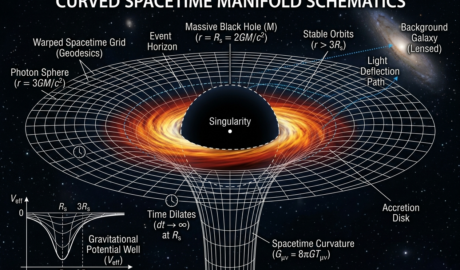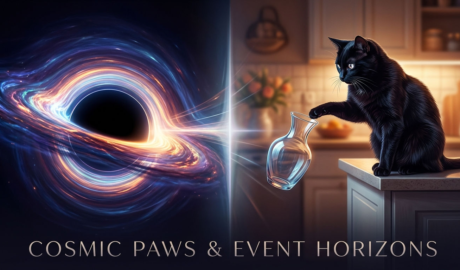
Black holes aren’t just cosmic devouring machines—to theoretical physicists, they are geometric structures built on mathematical spaces called manifolds. This post breaks down how manifold theory transformed our understanding of General Relativity: from resolving map artifacts at the event horizon and categorizing the four types of black holes, to using Penrose-Carter diagrams to map infinite spacetime onto a finite page. Ultimately, global manifold topology proves that once a star collapses past a critical point, a central singularity becomes an inescapable future moment in time.Continue Reading

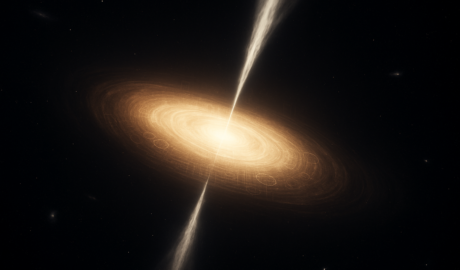
In the distant universe, there are objects so bright that they outshine entire galaxies. They are called quasars, short for quasi-stellar radio sources, and they are among the most powerful phenomena known to astronomy. A single quasar can emit more light than a trillion stars. To observers on Earth, theyContinue Reading

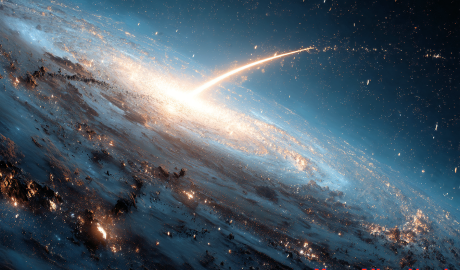
A breathtaking cosmic scene showing a bright hypervelocity star being slingshotted out of the dense, luminous core of a spiral galaxy. The star leaves behind a glowing plasma trail, bending space around it as it accelerates. The galactic core is rich with swirling gas, dust, and other stars, while distant spiral arms arc into the darkness. Background filled with starfields, interstellar clouds, and a sense of dynamic motion and power. Cinematic composition, high contrast lighting, astrophotography realism.

We often think of stars as stationary beacons, slowly wheeling across the sky over cosmic timescales. But not all stars play by the rules of calm celestial choreography. Some have been launched across the galaxy at unimaginable speeds—these are the hypervelocity stars. Discovered in 2005, hypervelocity stars (HVS) are stellarContinue Reading