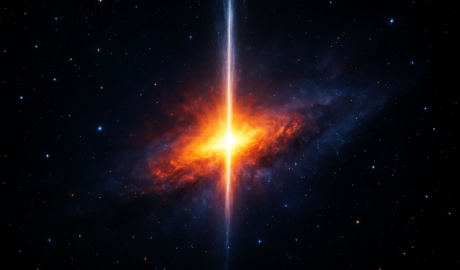
Gamma-ray bursts (GRBs) are extremely energetic events occurring in distant galaxies which represent the brightest and most powerful class of explosion in the Universe. These extreme electromagnetic emissions are second only to the Big Bang as the most energetic and luminous phenomena known. Gamma-ray bursts can last from a few milliseconds to several hours. After the initial flash of gamma rays, a longer-lived afterglow is emitted, usually in the longer wavelengths of X-ray, ultraviolet, optical, infrared, microwave or radio frequencies.

There are explosions in the universe so powerful that, for a few seconds, they outshine entire galaxies. They are called Gamma-Ray Bursts (GRBs). They arrive without warning, from random directions in the sky, releasing in seconds as much energy as the Sun will emit over its entire lifetime. For decades,Continue Reading
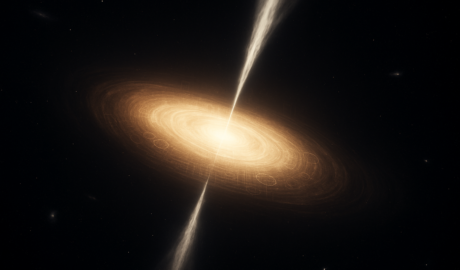
In the distant universe, there are objects so bright that they outshine entire galaxies. They are called quasars, short for quasi-stellar radio sources, and they are among the most powerful phenomena known to astronomy. A single quasar can emit more light than a trillion stars. To observers on Earth, theyContinue Reading

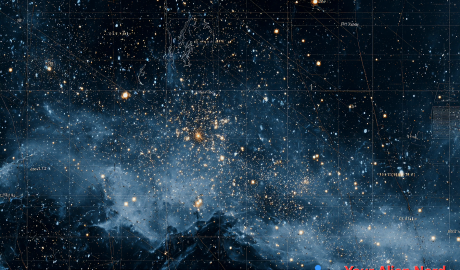
A deep-space star field based on archival astronomical plates, with one clearly missing star — an eerie gap surrounded by pinpoint stars, faint nebulae, and galactic haze, stylized like a comparison between 1950s photographic plates and modern digital imagery.

Change is usually slow in the vastness of space, where distances are measured in light-years and events unfold over eons. Stars are born, live, and die across millions or billions of years. Galaxies drift, collide, and evolve over cosmic epochs. But what happens when a star—or even an entire galaxy—vanishesContinue Reading

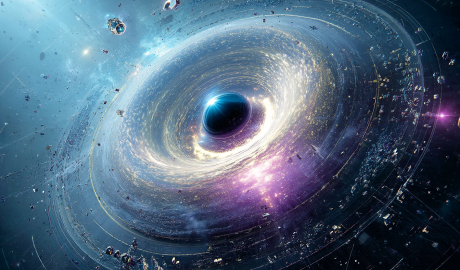
A surreal and dramatic cosmic scene showing a massive black hole surrounded by a luminous accretion disk, with a vast Dyson swarm of advanced alien megastructures orbiting it. The black hole distorts space around it, creating gravitational lensing effects. The swarm includes angular, metallic collectors, translucent energy sails, and glowing orbital platforms. Relativistic jets erupt from the poles into deep space, with some structures harvesting energy from the jet stream. The color palette features deep space blues, intense whites, and eerie purples. Style is cinematic, astrophysically realistic, and awe-inspiring.

Dark Harvest When we think of Dyson spheres, the first image that comes to mind is a vast shell or swarm of solar collectors encasing a star—an icon of mega-engineering from science fiction and speculative science. Initially proposed by physicist Freeman Dyson in 1960, this idea was a thought experiment:Continue Reading