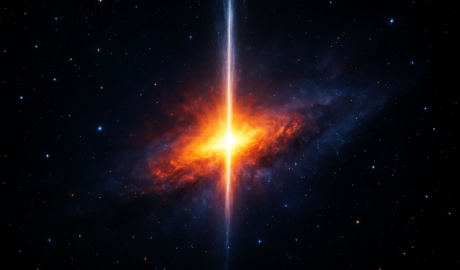
Gamma-ray bursts (GRBs) are extremely energetic events occurring in distant galaxies which represent the brightest and most powerful class of explosion in the Universe. These extreme electromagnetic emissions are second only to the Big Bang as the most energetic and luminous phenomena known. Gamma-ray bursts can last from a few milliseconds to several hours. After the initial flash of gamma rays, a longer-lived afterglow is emitted, usually in the longer wavelengths of X-ray, ultraviolet, optical, infrared, microwave or radio frequencies.

There are explosions in the universe so powerful that, for a few seconds, they outshine entire galaxies. They are called Gamma-Ray Bursts (GRBs). They arrive without warning, from random directions in the sky, releasing in seconds as much energy as the Sun will emit over its entire lifetime. For decades,Continue Reading

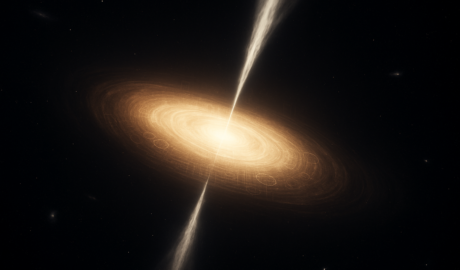
In the distant universe, there are objects so bright that they outshine entire galaxies. They are called quasars, short for quasi-stellar radio sources, and they are among the most powerful phenomena known to astronomy. A single quasar can emit more light than a trillion stars. To observers on Earth, theyContinue Reading

A surreal cosmic scene depicting a vast cat-shaped nebula made of luminous interstellar gas and dust, its glowing eyes and subtle feline outline emerging from the stars. Below, a small, fragile Earth floats in the cosmic void, bathed in soft blue light. The cat nebula gazes down as if protectively—or indifferently—watching over the planet. Ethereal atmosphere, rich color gradients (violet, indigo, turquoise), detailed galactic textures, cinematic lighting, highly realistic astrophotography style.

The Fermi Paradox has long haunted astronomers, philosophers, and science fiction writers alike: if the Universe is so vast and filled with billions of potentially habitable worlds, where are all the aliens? We send out radio waves, beam golden records into the void, and scan the skies with powerful telescopes—yetContinue Reading

What Is The Great Filter? Imagine the vastness of the universe, filled with billions of galaxies, each containing billions of stars, many of which have planets orbiting them. It seems statistically probable that life, even intelligent life, should have arisen elsewhere. This is the core of the Fermi Paradox, named afterContinue Reading