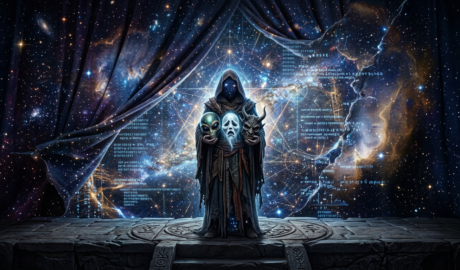
The Trickster Hypothesis: Is Someone—or Something—Playing Games with Reality?
This post develops the philosophical thread established in the previous two articles while giving the trickster hypothesis a distinctive identity. The historical examples of Joe Simonton’s pancakes, the Men in Black, and the Mothman reports provide memorable narrative anchors, while the simulation hypothesis offers a bridge to the larger questions about reality explored throughout the series.Continue Reading
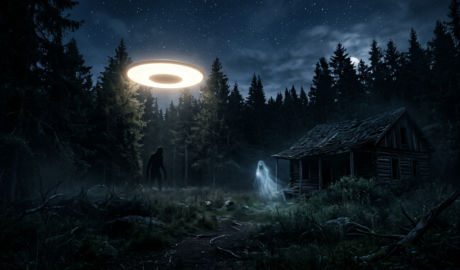
Exploring the Nature of High Strangeness: Aliens, Ghosts, and More
This new post about high strangeness builds on the first while introducing a stronger recurring theme: the possibility that different paranormal phenomena share a common source—or merely appear connected because of how the human mind interprets them.Continue Reading
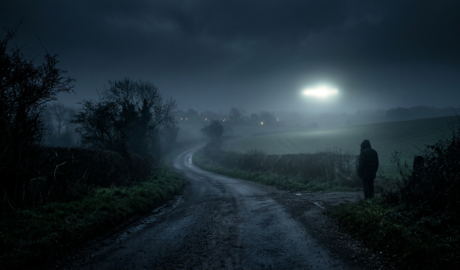
Beyond the Veil: Exploring High Strangeness
What if UFOs, ghostly apparitions, mysterious creatures, and impossible coincidences were not separate mysteries but different manifestations of something far stranger? Welcome to the unsettling world of high strangeness.Continue Reading
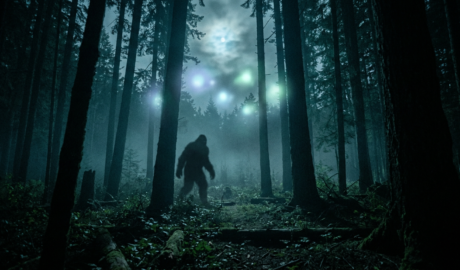
Bigfoot and UFOs: Is There a Connection?
Bigfoot is supposed to live in the forest. UFOs are supposed to come from the sky. At first glance, the two mysteries could hardly be more different. One belongs to cryptozoology: an elusive, perhaps undiscovered primate hiding in remote wilderness. The other belongs to ufology: mysterious objects and lights thatContinue Reading
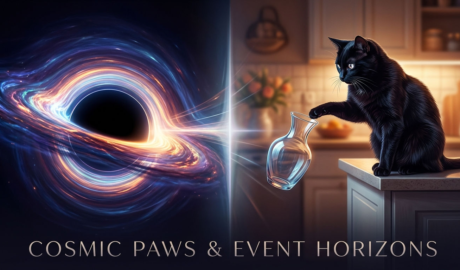
The Science of Light Traps: Cats and Black Holes
(I) Introduction In astrophysics, few concepts carry the weight, mystery, and sheer terror of an event horizon. It is the mathematical boundary around a black hole—where gravity becomes so intense that the escape velocity exceeds the speed of light. Step past this threshold, and no amount of energy in theContinue Reading
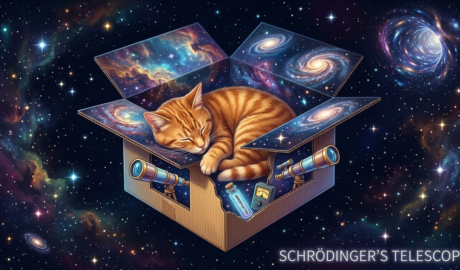
Schrödinger’s Telescope: Observing the Invisible Universe
In 1935, physicist Erwin Schrödinger devised a thought experiment to highlight the bizarre nature of quantum mechanics. He imagined a cat sealed inside a steel box with a tiny bit of radioactive material, a Geiger counter, and a vial of poison. If a single atom decayed, the poison would release; if it didn’t, the cat would remain unharmed. According to quantum theory, until someone opens the lid to look inside, the cat exists in a strange, simultaneous state of probability: it is both alive and dead at the exact same time. It’s a famous paradox, but what if we took that steel box and scaled it up to the size of the cosmos?Continue Reading
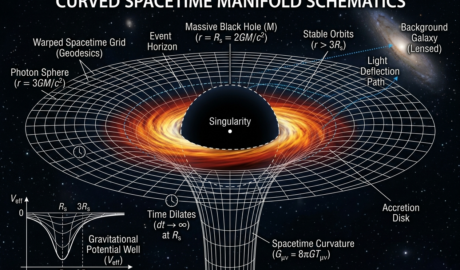
Beyond the Point of No Return
Black holes aren’t just cosmic devouring machines—to theoretical physicists, they are geometric structures built on mathematical spaces called manifolds. This post breaks down how manifold theory transformed our understanding of General Relativity: from resolving map artifacts at the event horizon and categorizing the four types of black holes, to using Penrose-Carter diagrams to map infinite spacetime onto a finite page. Ultimately, global manifold topology proves that once a star collapses past a critical point, a central singularity becomes an inescapable future moment in time.Continue Reading
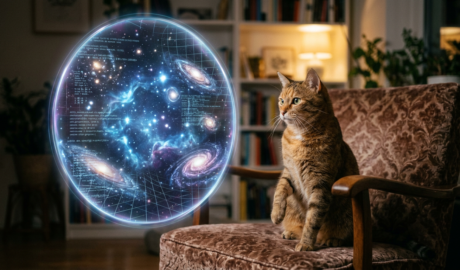
Is Our Universe a Simulation? Here’s the Evidence
Introduction Imagine waking up one morning and discovering the world around you behaves a bit like a very advanced computer program. Some people think that, just maybe, our universe could be a sophisticated simulation run by some higher-tech authors. Others shrug and say: “Nice idea, but there’s no solid proof.”Continue Reading