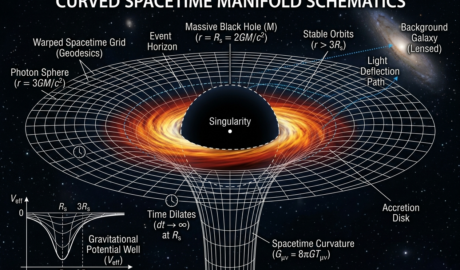
Black holes aren’t just cosmic devouring machines—to theoretical physicists, they are geometric structures built on mathematical spaces called manifolds. This post breaks down how manifold theory transformed our understanding of General Relativity: from resolving map artifacts at the event horizon and categorizing the four types of black holes, to using Penrose-Carter diagrams to map infinite spacetime onto a finite page. Ultimately, global manifold topology proves that once a star collapses past a critical point, a central singularity becomes an inescapable future moment in time.Continue Reading

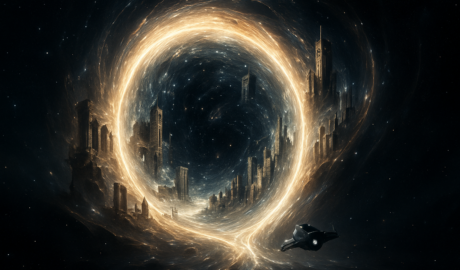
Time travel has always fascinated us. From H.G. Wells’ Victorian machine to modern cinematic paradoxes, the idea of revisiting the past feels both irresistible and deeply unsettling. But when we move from fiction to physics, something curious happens: the future seems accessible… while the past remains stubbornly out of reach.Continue Reading

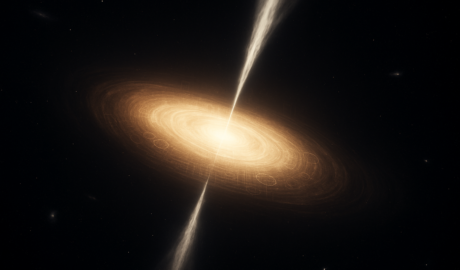
In the distant universe, there are objects so bright that they outshine entire galaxies. They are called quasars, short for quasi-stellar radio sources, and they are among the most powerful phenomena known to astronomy. A single quasar can emit more light than a trillion stars. To observers on Earth, theyContinue Reading

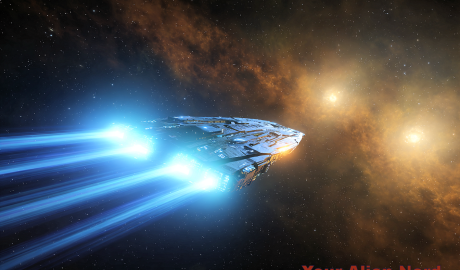
A sleek, advanced relativistic spacecraft traveling at near-light speed, glowing with blue-white ion trails and subtle spacetime distortions, approaching a distant binary star system with twin suns (Zeta Reticuli I and II), the stars glowing in pale gold and cool white, backdrop of deep space with nebulae and scattered stars, cinematic lighting, sense of scale and isolation, realistic hard science fiction aesthetic.

In the tangled corridors of UFO lore, few stories have captured the imagination quite like Project Serpo — the alleged top-secret exchange program between Earth and the inhabitants of Zeta Reticuli, a binary star system nearly 40 light-years away. According to leaked reports and whistleblower testimonies, twelve humans — tenContinue Reading