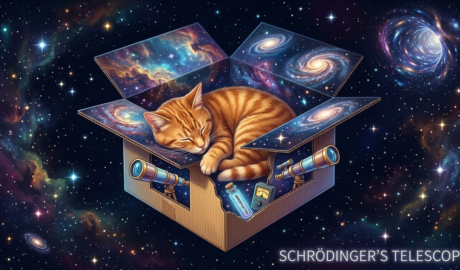
In 1935, physicist Erwin Schrödinger devised a thought experiment to highlight the bizarre nature of quantum mechanics. He imagined a cat sealed inside a steel box with a tiny bit of radioactive material, a Geiger counter, and a vial of poison. If a single atom decayed, the poison would release; if it didn’t, the cat would remain unharmed. According to quantum theory, until someone opens the lid to look inside, the cat exists in a strange, simultaneous state of probability: it is both alive and dead at the exact same time. It’s a famous paradox, but what if we took that steel box and scaled it up to the size of the cosmos?Continue Reading
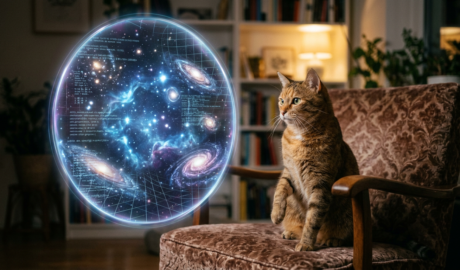

Cat sitting beside a glowing holographic cosmic map

Introduction Imagine waking up one morning and discovering the world around you behaves a bit like a very advanced computer program. Some people think that, just maybe, our universe could be a sophisticated simulation run by some higher-tech authors. Others shrug and say: “Nice idea, but there’s no solid proof.”Continue Reading

A lone stargazer standing on a hill at night, gazing up at a surreal, shifting sky where constellations appear to morph and realign in real time, trails of starlight bending unnaturally, a dreamlike atmosphere with faint cosmic glitches in the sky, soft moonlight casting shadows, subtle glow around the observer, ethereal and mysterious.

Introduction: You Remember It Differently… But So Does Everyone Else Have you ever confidently recalled a fact, name, or historical detail—only to find that the entire world seems to remember it differently? You’re not alone. Welcome to the Mandela Effect, a term coined by researcher Fiona Broome after she andContinue Reading

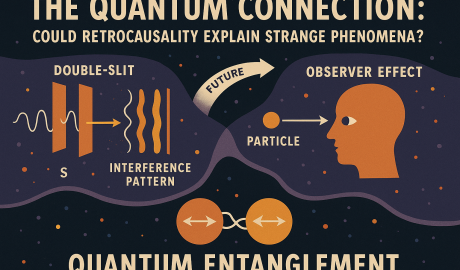
Retrocausality is the intriguing concept that the future can influence the past. It challenges the traditional, intuitive understanding of time and causality that we experience in our daily lives, where causes always precede their effects.

Introduction In physics, the flow of time is generally assumed to be unidirectional — that is, time moves forward from past to present and onward into the future. However, the idea of retrocausality challenges this assumption, suggesting that events in the future can influence the past. While this concept mightContinue Reading