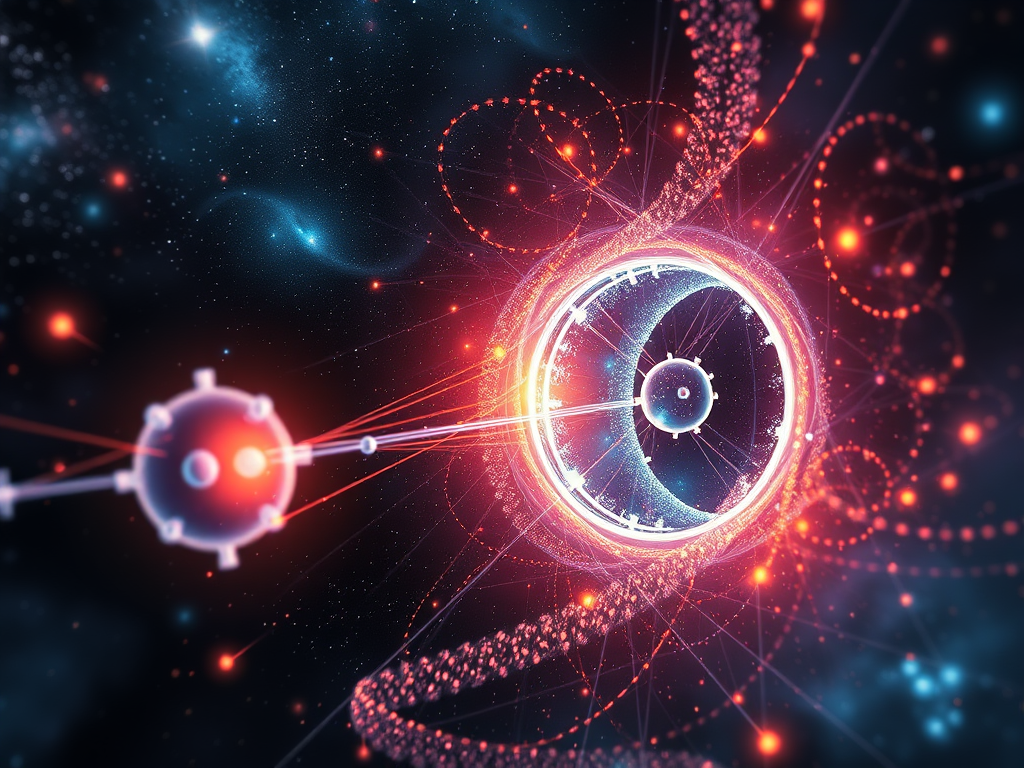
In 1935, physicist Erwin Schrödinger devised a thought experiment to highlight the bizarre nature of quantum mechanics. He imagined a cat sealed inside a steel box with a tiny bit of radioactive material, a Geiger counter, and a vial of poison. If a single atom decayed, the poison would release; if it didn’t, the cat would remain unharmed. According to quantum theory, until someone opens the lid to look inside, the cat exists in a strange, simultaneous state of probability: it is both alive and dead at the exact same time. It’s a famous paradox, but what if we took that steel box and scaled it up to the size of the cosmos?Continue Reading
A sleek black cat sits silhouetted against a soft, glowing spiral of light stretching horizontally, subtle echoes of the cat’s form appear before and behind it along the spiral, symbolizing past and future, minimal sacred geometry elements subtly woven into the background, soft starlit sky with faint constellations, elegant and clean composition, mystical and timeless mood,

At first glance, morphic resonance and retrocausality may seem unrelated — one arises from biology and consciousness studies, the other from interpretations of quantum physics. But dig deeper; they may describe different facets of the same underlying reality. Morphic Resonance in Brief Morphic resonance is the idea proposed by RupertContinue Reading

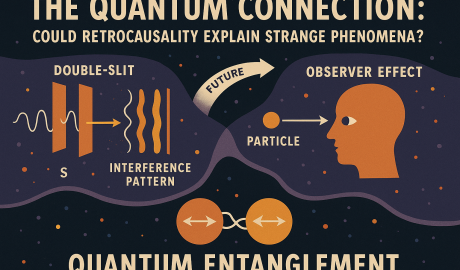
Retrocausality is the intriguing concept that the future can influence the past. It challenges the traditional, intuitive understanding of time and causality that we experience in our daily lives, where causes always precede their effects.

Introduction In physics, the flow of time is generally assumed to be unidirectional — that is, time moves forward from past to present and onward into the future. However, the idea of retrocausality challenges this assumption, suggesting that events in the future can influence the past. While this concept mightContinue Reading