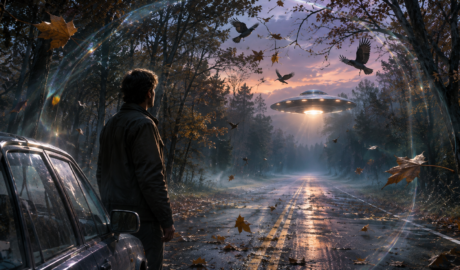
The Oz Factor: a deserted country road passing through a dense forest at twilight, with a lone witness standing beside a motionless car. The entire landscape appears unnaturally frozen: leaves suspended in midair, birds motionless above the trees, and a luminous, unidentified object hovering silently in the distance. A faint circular distortion around the witness could suggest that ordinary reality has been temporarily suspended.

Imagine walking through a familiar landscape when, without warning, every sound disappears. The birds stop singing. The wind falls silent. Time seems to slow down, and the world around you becomes strangely unreal. You are still standing on Earth—but somehow, you no longer feel that you belong to it. WelcomeContinue Reading
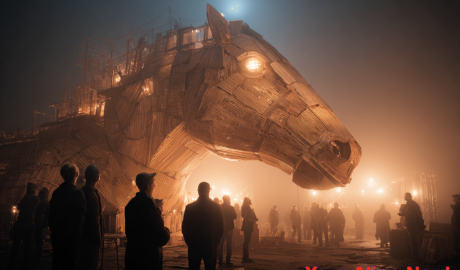
A mythic, symbolic scene depicting a Trojan Horse reimagined as a UFO-shaped construct: a smooth, enigmatic craft-like form made of wood, symbols, and starlight rather than metal, standing at the gates of a human city. The structure is hollow, subtly glowing from within, filled not with soldiers but with floating questions, archetypal symbols, masks, and shifting lights. Onlookers welcome it with curiosity and awe, unaware of its true nature. The atmosphere is dreamlike and allegorical, blending ancient myth with cosmic imagery.

In 1970, computer scientist and ufologist Jacques Vallée published one of the most provocative works in the history of UFO studies: Operation Trojan Horse. His thesis was radical then — and feels eerily prescient now. Vallée argued that UFOs were not extraterrestrial spacecraft, but manifestations of an intelligence that interactsContinue Reading